[DEBUG] The "False Interrupt" Issue with DMA + Idle Interrupt
Program Logic Error: The "False Interrupt" Issue with DMA + Idle Interrupt
Problem: The DMA receive functions for USART1 and USART3 are ineffective immediately after power-on; they only work normally after manually pressing the reset button.
Analysis: This is a typical "race condition" problem in the "DMA + idle interrupt" scheme. The reasons are as follows:
- As soon as the STM32 powers on, its RX pin has already received the "idle" high level from the computer's serial port tool.
- When the initialization code executes to the point of enabling the "idle interrupt", the USART peripheral immediately detects this already existing idle state and generates a "false" idle interrupt.
- This interrupt was handled incorrectly (because the DMA hadn't received any data yet), causing the system to miss the response to the first frame of real data.
- During manual reset, the timing is slightly different, avoiding this problem.
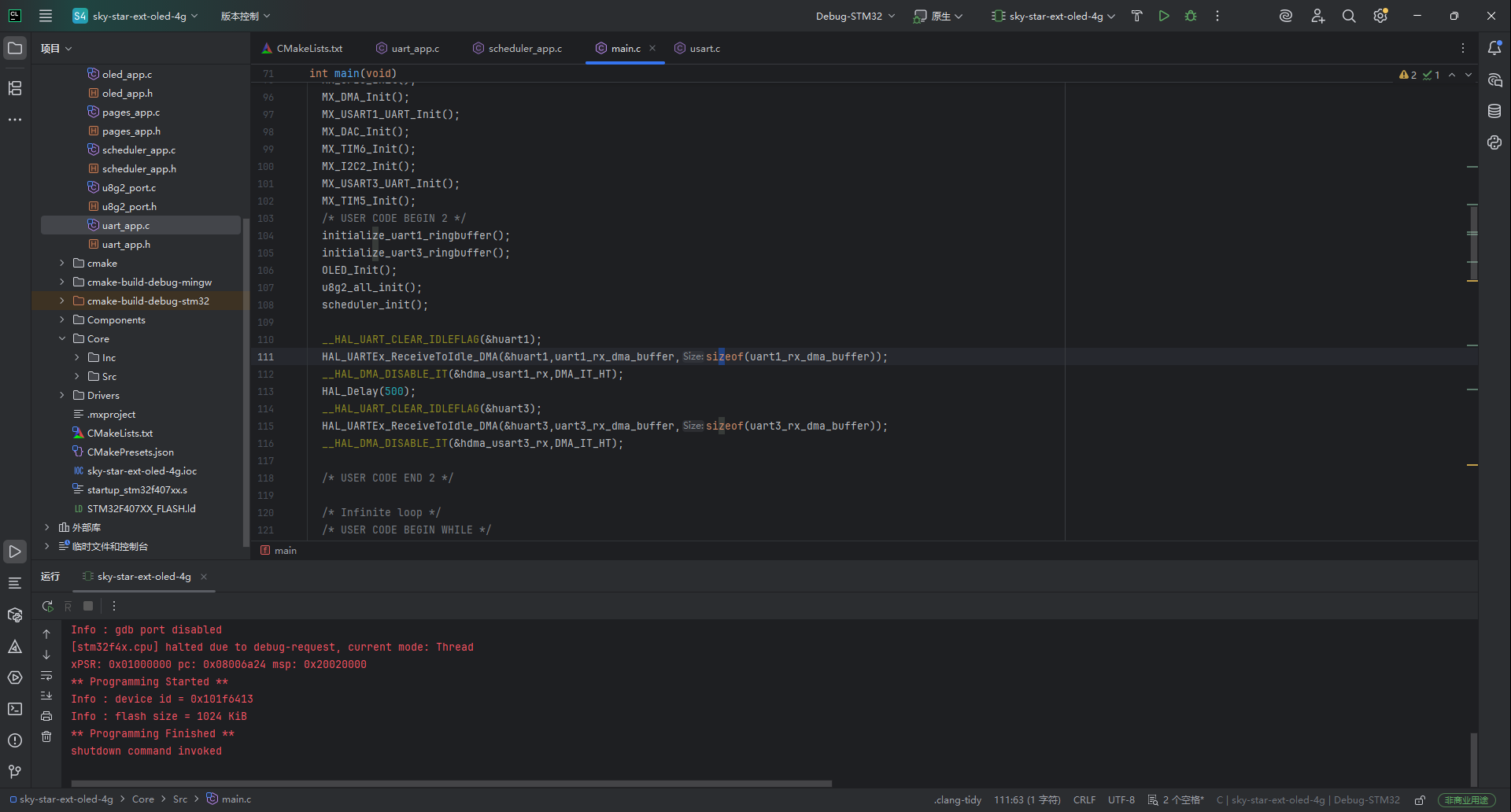
Solution: Before starting DMA reception and enabling the idle interrupt, forcibly clear the USART idle flag once. The code implementation is:
Code Structure Optimization—Separation of Initialization and Business Logic
Problem Analysis: Even after adding the code to clear the flag, placing it in the Init function still yields unsatisfactory results. The deep-seated reason is:
- In the
mainfunction, afterMX_USART1_UART_Initfinishes execution, the program continues to execute initialization for other peripherals (MX_I2C2_Init,MX_USART3_UART_Init, etc.). - Starting a background task that requires continuous operation (like UART DMA) prematurely in the middle of an unstable, dynamic initialization sequence is easily interfered with by subsequent initialization actions of other peripherals (such as resetting DMA channels, changing clocks, modifying interrupt priorities, etc.), leading to failure.
Solution:
- Remove all business startup-related code (such as
HAL_UARTEx_ReceiveToIdle_DMA) from theMX_..._Init()functions, allowing them to be responsible only for pure hardware parameter configuration. - Migrate the business startup code, along with the fix, uniformly to the
/* USER CODE BEGIN 2 */section of themainfunction.
Result: This ensures that all hardware peripherals are configured and the system has entered a stable state before starting application layer tasks like UART DMA reception. The program behavior becomes reliable and meets expectations.

image-20250916212502245
Update: You need to add a HAL_Delay(500); delay function before the initialization of the two serial port peripherals; otherwise, the DMA reception for USART3 may also fail.
Summary
- Beware of Timing and Race Conditions: Asynchronous operations like interrupts and DMA are very prone to timing issues. "Abnormal on power-up, normal on reset" is a typical signal.
- Separate Hardware Configuration from Business Startup: This is the most important principle.
- Configuration: Let the
MX_..._Initfunctions do only one thing—configure hardware registers according to CubeMX settings, putting the hardware in a "standby" state. - Startup: In the
mainfunction, wait until all hardware configurations are complete, then start them in the order of business logic (such as enabling DMA, starting timer PWM, etc.).
- Configuration: Let the
Following the principle in point 2 can avoid over 90% of difficult-to-troubleshoot embedded system initialization problems and is the necessary path for code to become professional and robust.