2026 CIMC Siemens Cup Industrial Embedded System Development Competition Item Explanation Summary
I. Software Functional Requirements (Continued)
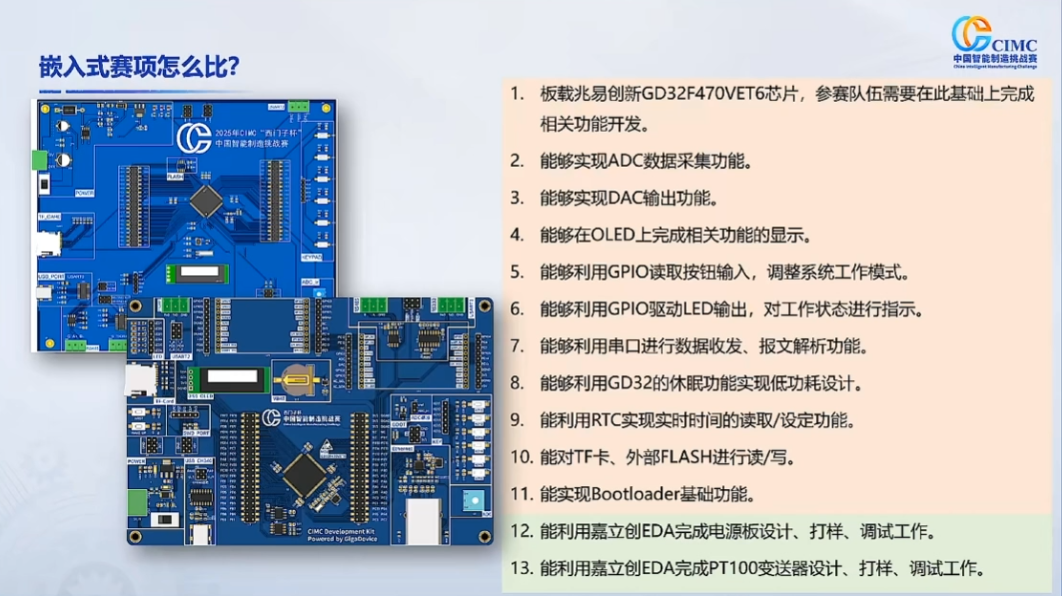
image-20260314105056173
Requirement 8: Serial Communication and Message Parsing
Capable of using the serial port to achieve data transmission and reception and message parsing functions.
Requirement 9: Low Power Design (GD32 Sleep Function)
Implement low power design by utilizing the GD32 sleep function.
Specific Requirements:
- Connect a current meter in series between the power supply and the development board
- Observe the current changes before and after entering the low power sleep mode to determine if it successfully enters the low power mode
- Design independently: under what conditions to enter low power mode, how to wake up (timed wake-up / external interrupt wake-up / other methods), with some freedom in design
Requirement 10: RTC Clock
Implement the clock function using RTC (no change from last year).
Requirement 11: TF Card / External Flash Read and Write
Achieve data read and write through TF card and external Flash (no change from last year).
Requirement 12: Bootloader Basic Function (New This Year)
Implement the basic functions of Bootloader, i.e., board-level system upgrade without using SWD debugger (such as OTA upgrade, upper machine upgrade, etc.).
Details to Consider:
- File verification (header verification, version number comparison)
- System version number management
- Save configuration parameters to Flash before upgrade and restore them after upgrade
II. Hardware Requirements
The hardware part requires the use of JiaLiChuang EDA to complete circuit design, PCB fabrication, manufacturing, and debugging, with two types of circuit boards:
Power Supply Board
- Input: 18V~36V
- Output: 5V (to power the control board)
- Design a stable and reliable step-down power supply circuit
PT100 Transmitter Sampling Board
- For temperature detection
- Complete the curve fitting and calibration of PT100 input and output (recommended to use three bottles of mineral water at different temperatures for testing)
- Output the final result in the specified floating-point number format and be able to parse it back to the temperature value
Both boards need to be fabricated and manufactured.
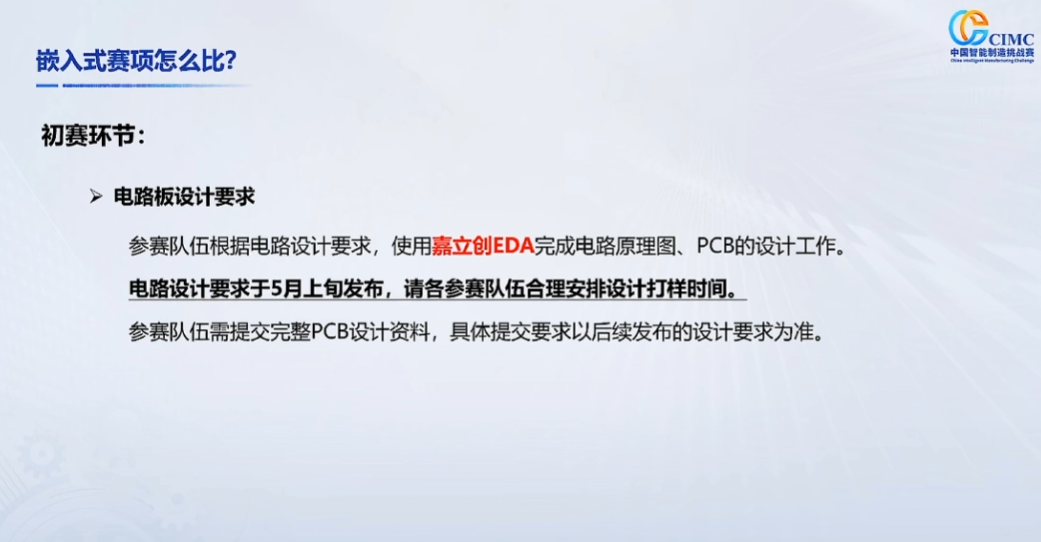
image-20260314105248951
III. Chip Requirements
- Both hardware boards must use the two chips specified by GigaDevice (specific models will be announced on the official website in mid-April)
- Purchase the new version of the development board (second edition released in April): each board comes with three samples of the two chips
- Students using the old board from last year: can purchase separately through the following channels:
- Official embedded purchasing platform (resource package will be available on the platform in mid-April, sold at chip cost price, three pieces per chip)
- Contact the supplier or other channels directly
- No restrictions on the purchasing channel, only the specified chip models are required
IV. Preliminary Competition Timeline
| Time | Event |
|---|---|
| Early May | Hardware design question released, everyone has about a month to complete design, fabrication, and debugging |
| May 31 | Registration deadline (strongly recommended to register early, see below explanation) |
| 8 PM on June 5 | Preliminary question and solution template released |
| June 5 to June 8 | Embedded software development time |
| 8 PM on June 8 | Deadline for recording embedded program and functional demonstration video (any content after 8 PM is not counted in the score) |
| 11:59 PM on June 8 | Deadline for uploading all materials (recommended to upload early, staggered submission, avoid last-minute submission) |
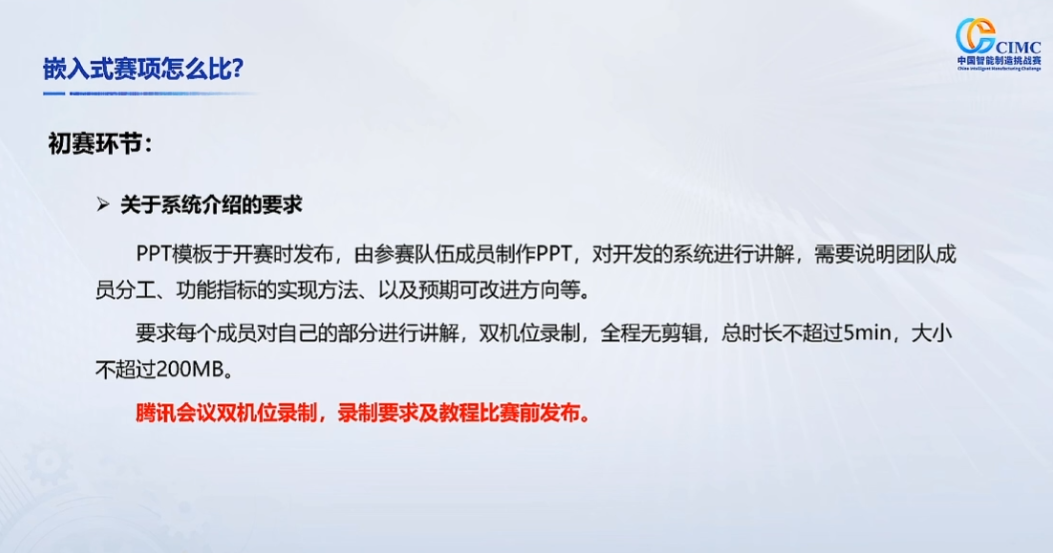
| June 8 to June 11 | System solution writing + preparation of presentation video |
| Noon on June 11 | Deadline for submitting system solution and presentation video |
Reminder about Registration Time
Last year, some students registered on May 29 and 30, which led to a very tight schedule afterwards. PCB fabrication cycle:
- Jialichuang Express: 12~24 hours (express fee is relatively high)
- Normal fabrication: 3~4 days + shipping 1~2 days
If problems are found after PCB fabrication, redesign is needed, which will be very time-consuming. It is recommended to determine participation early and prepare in advance.
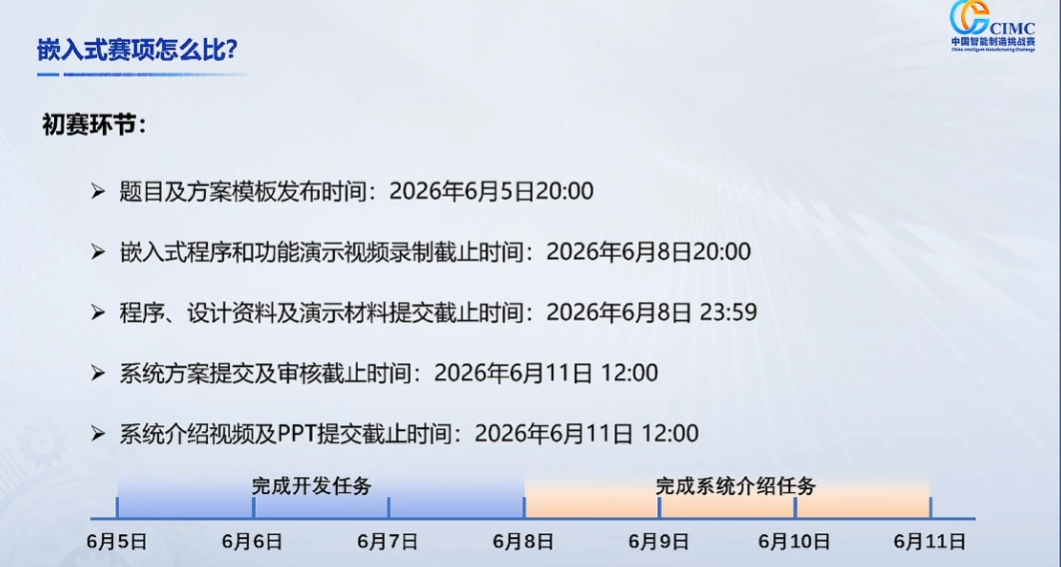
image-20260314105121417
V. Scoring Mechanism
Preliminary Total Score Composition
- Total score for implementation process: Embedded software accounts for 60%, hardware development for 40% (tentative, the exact ratio will be confirmed by the expert group)
- Technical documents and presentation video: Combined account for 40% of the total score
Function Completion Degree Coefficient Mechanism
To prevent situations where "few tasks are completed but the documentation is well-written", the Function Completion Degree Coefficient is established:
- The proportion of completion in the implementation part will determine the coefficient for the documentation and presentation part scores
- It is not possible to compensate for functional shortcomings by merely piling up documentation
Review Mechanism
The blind review mechanism is adopted, where materials are assigned to different experts for review to prevent any influence on the fairness of the scoring due to the leakage of school or personal information.
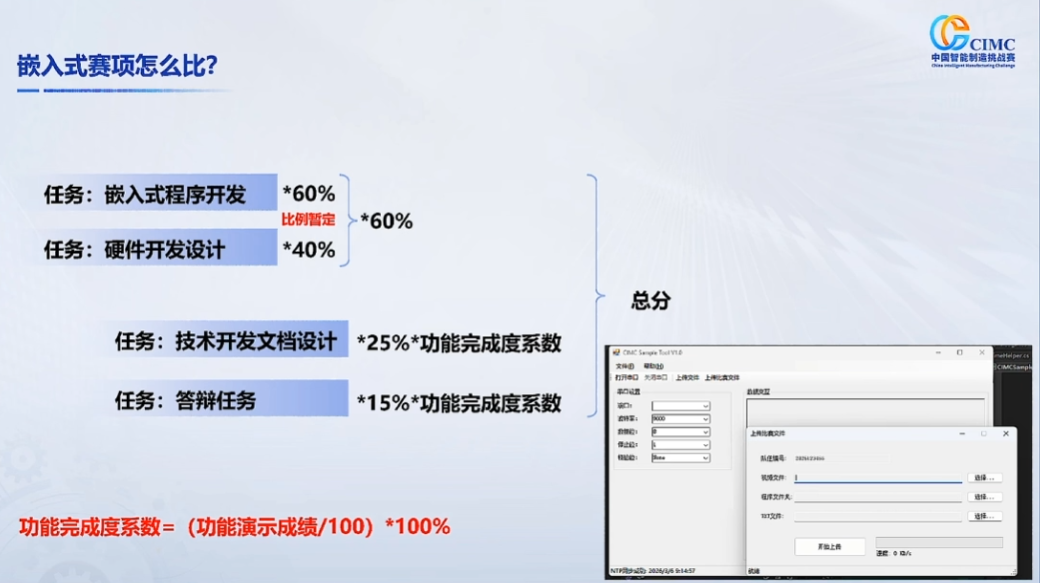
image-20260314105301836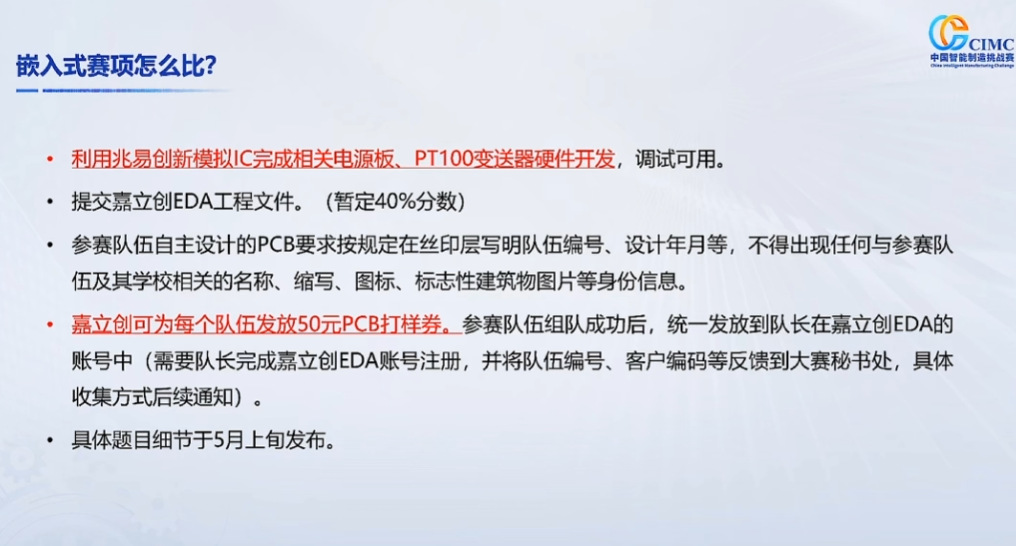
image-20260314105315787
VI. Functional Demonstration Requirements
Upper Machine Scoring Process
- The official provides an upper machine software before the competition (pre-set message)
- Operation process: click the upper machine button → send the message to the embedded program → the embedded program parses the message and assembles the uplink message → the upper machine parses the returned message and displays it → automatically generate a scoring file
- Submit: The scoring file automatically generated by the upper machine (record the complete operation process and data)
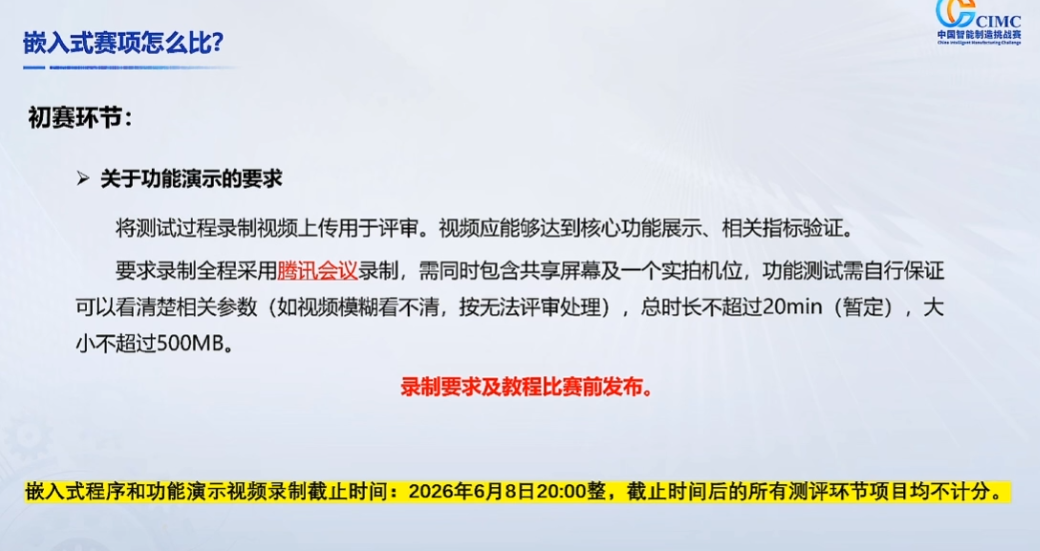
Video Recording Requirements
- Record the entire process using Tencent Meeting
- Video size should not exceed 500MB (Tencent Meeting recording is about 300MB)
- Specific recording requirements will be published separately before the competition
- The video must clearly show the core indicators, for example:
- Current changes under low power mode
- PT100 temperature measurement (place the sensor in different temperature water bottles)
- OLED display content (font size should not be too small, it is recommended to display in two lines to ensure clarity and readability)
Scoring Deadline Explanation
June 8 at 8 PM is the deadline for functional demonstration. Any operation records after 8 PM in the scoring file will not be counted in the score.
VII. Material Submission Method
- Use the official upper machine software (which is also the material upload tool)
- Team number and key will be distributed before the competition, and after logging in, materials should be uploaded according to the categories
- The system has an automatic renaming mechanism, so it is essential to upload the corresponding files under the correct category, otherwise incorrect naming will result in the file not being recognized
VIII. Common Points of Deduction from Last Year (Key Reference)
1. Failure to Submit Materials as Required
- Incorrect team number entry
- File naming does not meet the requirements
- Consequence: The folder received by the expert is empty, making it impossible to review, resulting in a score of 0
2. Poor Video Recording Quality
- OLED font is too small (made into 4 lines, characters are unreadable)
- Blurry images, skewed angles, reflections present
- Recommendation: OLED display in two lines is sufficient, ensure clear and direct view during recording
3. Code Plagiarism (High Risk Area)
The following situations will be considered as completely identical code:
- The logic application layer code is exactly the same without any modifications
- Only comments are modified or the order of functions is changed
- Only variable names are modified (such as changing to
variable1,a,b, etc., meaningless names) - A lot of invalid and confusing code is added (such as an
elsebranch that will never be executed)
Normally, the same person writing the code twice will not be exactly the same. If two sets of code have exactly the same logic structure, variable names, and bracket positions, they will definitely be considered as plagiarism.
4. AI-Generated Reports
- Many reports from last year were judged as AI-generated by the experts, with high AI rate
- The purpose of the report: to train logical thinking, the ability to analyze and solve problems, and academic writing skills
- AI-generated content lacks personal depth thinking and often contains errors. Without corresponding knowledge reserves, it is impossible to effectively review and revise
- The report must be written by yourself, which is also an important part of the competition assessment
5. Personal Information Appears in the Presentation Video
- The appearance of names, school names, school logos, etc., in the video will result in deductions
- Do not use templates with school identification on the PPT, and do not mention names in the opening introduction
IX. Learning Resources
- The Learning Tong and Bilibili platforms are continuously open for participants, and you can first learn the course content already online from last year
- Starting from this April, the course system for this year will be gradually updated
- The course content ranges from beginner to advanced, and is closely linked to real enterprise needs
The above is the complete explanation for the Industrial Embedded System Development competition item. The questions from the QA session will be organized separately.